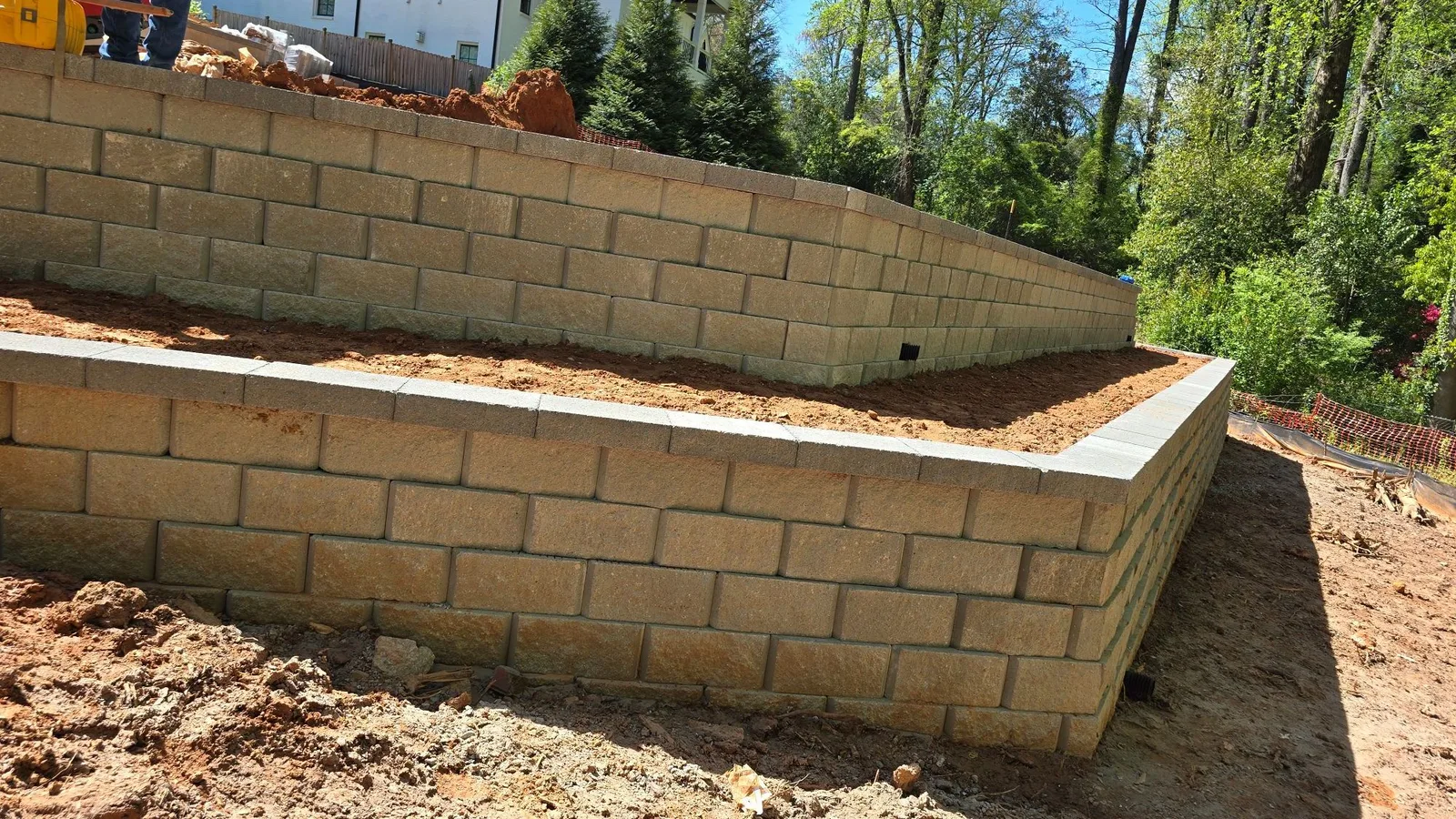
A retaining wall doesn't fail all at once. It leans a little after the first wet winter, a bulge shows up in the middle of the run a year or two later, a cap slides off, a crack opens at a corner. By the time most people call us, the wall has been moving for years. Almost every one of those walls has the same story: it looked fine the day it was built, and the things that would have kept it standing were the things nobody could see.
The first is the base. A wall needs a trench cut below grade, filled with crushed stone and compacted flat, with the first course set level and partly buried. Walls built straight on the dirt — or on a thin skim of gravel that was never compacted — sink unevenly, and once the first course tips, everything above it follows. If your wall is leaning as a whole, and the lean is worse at one end, this is usually the reason.
The second is water. Georgia clay holds water like a bathtub, and every summer thunderstorm loads the ground behind the wall with it. The weight of saturated soil pushing on a wall is several times the weight of the same soil dry. A properly built wall has a perforated drain pipe at the base, a foot or so of clean gravel behind every course, and an outlet so the water has somewhere to go. Without those, the wall is holding back a hillside and a pond. A bulge in the middle of a run, or a wall that leans more after heavy rain, is a drainage failure.
The third is reinforcement. Above about three or four feet, a block wall can't hold the slope on its own weight; it needs geogrid — a mesh laid back into the soil at intervals and locked between courses — to tie the wall into the ground it's holding. Taller walls built without it, or with the grid too short, are the ones that lean from the top. Timber walls have the same problem when the deadmen are missing or have rotted through.
So what does a proper repair involve? Honestly, for most walls it means taking the failed section — or the whole thing — down and rebuilding it. Patching the face of a wall that's being pushed by wet soil buys a season, not a fix. A rebuild starts with the excavation: the old wall comes out, the soil behind it is cut back, and a real base goes in. Then the wall goes back up with a slight batter into the slope, drain pipe at the bottom, gravel behind every course, geogrid where the height calls for it, and the top graded so surface water runs away from the wall rather than into it.
That's the work we do most. Rebuilding walls that somebody else built without those things is the biggest part of our retaining-wall business across Forsyth County and Cherokee County, and it's the reason we build new walls the way we do. If your wall is leaning, bulging or cracked, call us before it gets worse — we'll look at it for free, tell you plainly whether it's a partial rebuild or a full one, and give you a price in writing.